

News
07
Aug
How to Choose a Commercial Coffee Vending Machine: A Feature-by-Feature Buying Guide
Introduction: A Coffee Vending Machine Is a Piece of Unattended Equipment — Treat the Spec Sheet Seriously
A commercial coffee vending machine runs unattended for most of its operating hours, which means every feature on the spec sheet either reduces your maintenance burden or adds to it. This guide walks through the components that actually matter when comparing machines — brewing technology, display and interface, payment support, connectivity, and automated maintenance — so you know what to check before you commit to an order.
1. Brewing System: What's Actually Making the Drink
Not all "automatic coffee vending machines" use the same underlying brewing technology, and this affects both drink quality and maintenance complexity.
Instant coffee systems use powder canisters and a mixer to produce drinks quickly and consistently, with lower maintenance complexity than bean-based systems — a strong fit for high-volume, fast-turnover locations like transit hubs and offices
AI-assisted brewing systems on modern machines are designed to replicate the process steps of a professional barista — controlling variables like mixing speed and dose more precisely than older, simpler dispensers
Adjustable dosing — for both coffee bean and instant powder machines, the ability to fine-tune dose (commonly adjustable in small increments) lets operators calibrate taste and control ingredient cost per cup
Multiple mixer units allow a machine to prepare multiple drink types or multiple cups in parallel, which matters for reducing wait time during peak usage windows
Buyer tip: If your target location has heavy peak-hour traffic (a lunch rush, a morning commute surge), prioritize machines with multiple mixers and a fast per-cup cycle time over machines optimized purely for drink complexity.
2. Display and User Interface
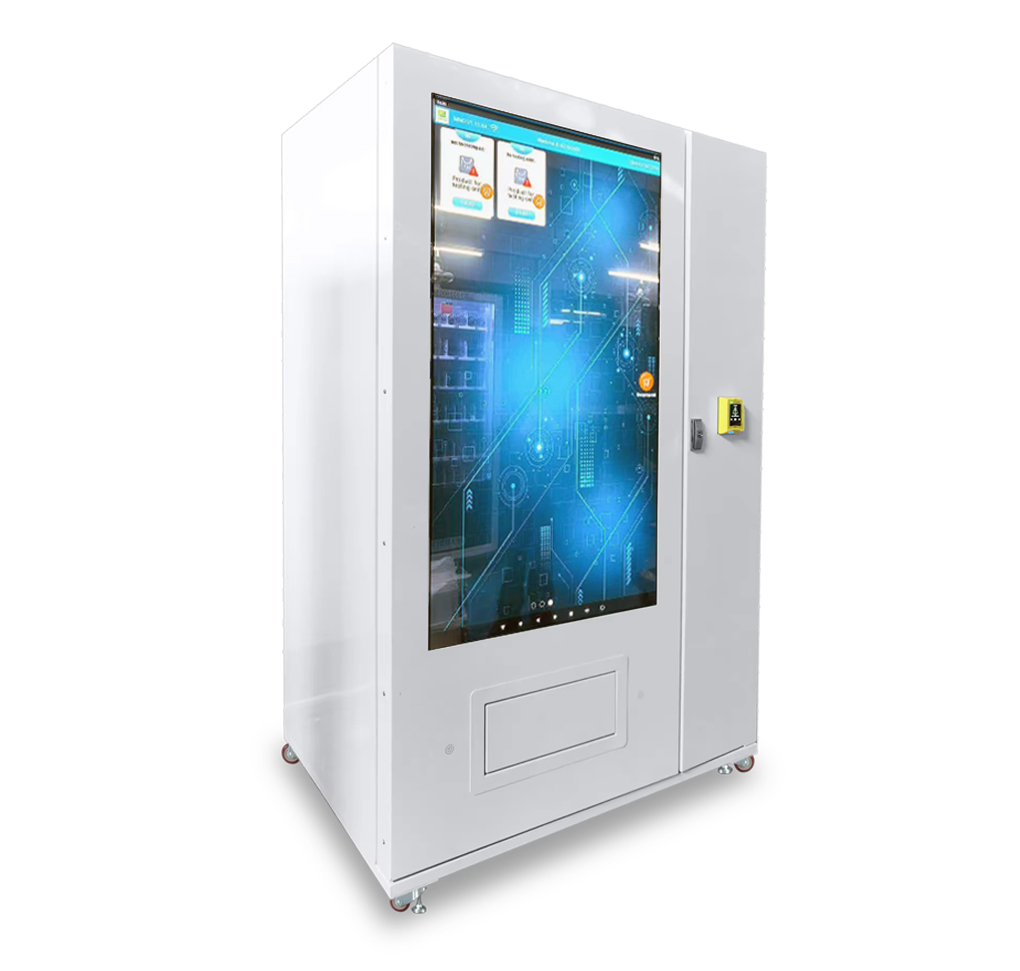
Primary touchscreen — commonly available in sizes like 15.6 inches for the core ordering interface, offering a capacitive touch experience similar to a tablet
Secondary advertisement screen — larger displays (20+ inches) can run promotional content, branding, or even third-party advertising, turning the machine into a secondary revenue or marketing channel rather than just a beverage dispenser
Multi-platform software support — look for machines that support standard operating environments (Linux, Android, Windows), which generally means broader compatibility with vending management software and easier long-term maintenance
3. Cup and Ingredient Capacity
Cup capacity — check both the total cup count the machine holds (commonly in the hundreds for a floor-standing unit) and the supported cup diameter range, to make sure it matches your preferred cup size
Ingredient canister capacity — instant powder canisters are typically measured in liters (a multi-liter capacity per canister is standard on floor-standing units), and more canisters mean more drink variety without needing to restock as frequently
Water tank capacity — for machines not connected to a direct tap water line, check the built-in water tank size, since this determines how many drinks can be served between refills
Buyer tip: Match cup and ingredient capacity to your realistic daily volume and servicing schedule — a machine visited weekly needs meaningfully more on-board capacity than one serviced daily.
4. Payment and Connectivity
Cashless payment support — an MDB (Multi-Drop Bus) interface is the industry-standard way to integrate card readers, mobile payment terminals, and coin/banknote acceptors into a vending machine
Multiple payment module options — RFID, banknote acceptors, coin mechanisms, and mobile payment platforms are often available as configurable add-ons, letting you match payment methods to your target market's habits
WiFi as standard, 4G as an option — WiFi connectivity is now a baseline expectation for remote monitoring, while 4G is worth adding for locations without reliable WiFi coverage
IoT and cloud platform integration — remote control interfaces let operators check machine status, sales data, and configuration without a site visit, which is especially valuable for vending routes covering multiple locations
5. Security Features
RFID automatic locking with electromagnetic induction unlock protects the machine's internal components and cash handling (where applicable) from tampering
Code lock or emergency lock access for the service door balances day-to-day security with the practical need for technicians to access the machine for maintenance
Component-level status reporting — valves, motors, and other executable components that report their own status (blocking, over-current, disconnection) help operators catch a developing issue before it causes a full breakdown
6. Automated Maintenance Features
This is where machines genuinely differentiate on total cost of ownership, since a machine's low sticker price doesn't matter much if it requires constant manual servicing.
Daily automatic cleaning reduces the manual cleaning burden and helps maintain consistent drink quality
Automatic descaling protects the internal water system from mineral buildup without requiring a technician visit
Automatic grinder powder removal (on bean-based machines) keeps the grinding mechanism clear between uses
Waste water bucket full-water detection and similar sensors prevent overflow issues and alert operators before a problem becomes a service call
Buyer tip: For vending routes managing many machines across scattered locations, prioritize automated maintenance features heavily — they directly reduce the number of site visits your team needs to make.
7. Data and Reporting
Standardized data systems, such as EVA-DTS, make it far easier to pull sales and machine-status data into third-party vending management software rather than relying on manual reporting
Product price setting and vending data statistics built into the machine's own software give operators visibility into performance without needing a separate analytics platform
App-based drink customization interfaces, where available, let end users adjust taste preferences, which can improve customer satisfaction in office or hospitality settings where the same users return regularly
Feature Checklist Before You Order
| Category | What to Confirm |
|---|---|
| Brewing | Instant vs. bean-based, number of mixers, dose adjustability |
| Display | Primary screen size, secondary ad screen, supported software platform |
| Capacity | Cup count, cup diameter range, canister/water tank size |
| Payment | MDB support, available payment modules, mobile payment compatibility |
| Connectivity | WiFi standard, 4G availability, IoT/cloud remote monitoring |
| Maintenance | Automatic cleaning, descaling, grinder cleaning |
| Security | Locking mechanism, service access method |
| Power | Voltage/frequency compatibility with your target market |
Frequently Asked Questions
What's the difference between an instant coffee vending machine and a bean-to-cup machine?
An instant coffee machine mixes powder-based ingredients with hot water for faster, lower-maintenance service, while a bean-to-cup machine grinds whole beans for each cup, generally offering richer flavor at the cost of higher maintenance complexity (grinder cleaning, bean hopper management).
What payment methods should a modern coffee vending machine support?
At minimum, look for MDB interface support, which allows integration of card readers and mobile payment terminals. Depending on your market, RFID, banknote acceptance, and coin mechanisms may also be worth including as configurable options.
How important is remote monitoring for a coffee vending machine?
It matters most for operators managing multiple machines across different locations, since remote status and sales data monitoring reduces the need for routine site visits and helps catch maintenance issues before they cause downtime.
Do coffee vending machines require daily servicing?
Machines with automated cleaning, descaling, and grinder-clearing features significantly reduce — though don't fully eliminate — the need for manual servicing. Actual servicing frequency depends on usage volume and ingredient capacity relative to your location's traffic.
Conclusion
The right commercial coffee vending machine isn't necessarily the one with the longest feature list — it's the one whose brewing system, capacity, payment options, and maintenance automation actually match your location's traffic pattern and your team's servicing capacity. Work through the checklist above against your specific use case before comparing machines on price alone.
Need help matching a coffee vending machine configuration to your business or vending route? Contact our team for a tailored specification and quote.
Contact Us
📞 Phone/WhatsApp: +86 132 1355 7186
📧 Email: sales@buysmartlocker.com
Our Contact
Minno Furtniture
Customize smart storage lockers,parcel delivery lockers, key management cabinet,Vending machines,Office/School and home furniture.
-
Call For Inquiry
-
Send Us Email
sales@buysmartlocker.com
Need Help For Project!
We are ready to help your next projects, let’s work together
 WhatsApp
 sales@buysmartlocker.com
 +8613213557186